Inside the Phoenix Park: Unveiling the Criminal Chain of a Cross-Border Pig-Butchering Scam Factory in Myawaddy, Myanmar
### 【I. Deceptive Recruitment and Cross-Border Trafficking Traps】
In March 2025, 24-year-old Chen Hao from Guangxi spotted a job posting for a "Southeast Asian e-commerce customer service" position offering RMB 12,000 monthly salary, round-trip airfare, and visa sponsorship. The workplace was listed as "Bangkok's New Economic Zone, Thailand." After contacting "Dingsheng International Human Resources," he underwent a video interview and received an electronic contract stamped with a Thai tech company's official seal.
On March 18, Chen arrived at Bangkok's Suvarnabhumi Airport. Two Cantonese-speaking men claimed they needed to process his work visa and transferred him to a modified minibus. After six hours of driving, the vehicle stopped at Mae Sot on the Thai-Myanmar border. "They suddenly seized my passport, saying the job was actually in Myawaddy, Myanmar. Refusal meant being abandoned in the mountains," Chen recalled. Under armed guard, he and 12 other job seekers boarded speedboats across the Moei River into Myanmar.
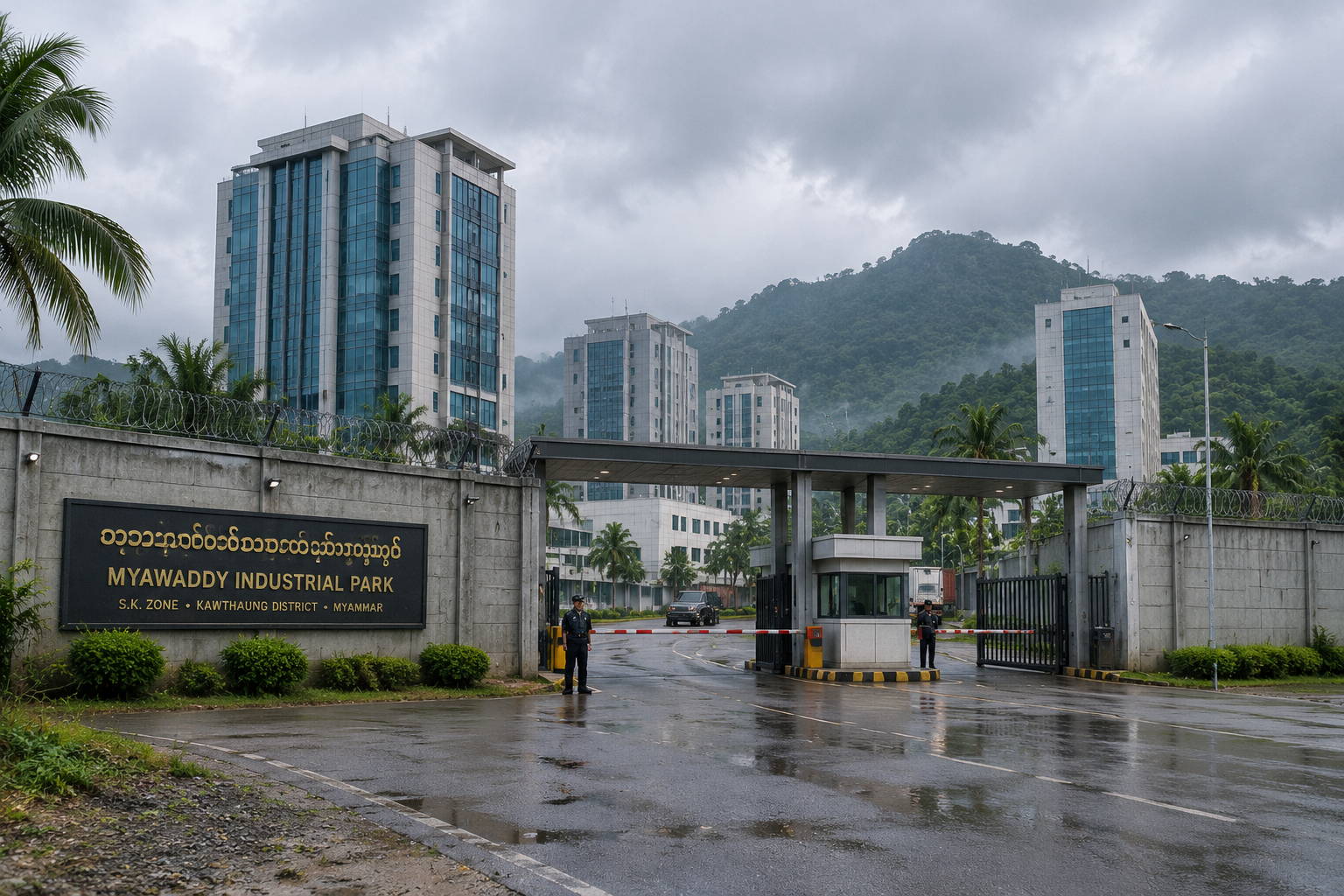
Phoenix Park, located in Myawaddy's Shwe Kokko Special Economic Zone just 15km from the border, spans 300 acres with 12 reinforced concrete buildings. Satellite imagery provided by Myanmar anti-fraud volunteer Lin Feng shows 3-meter electrified fences and watchtowers at each corner. When Chen reached Building A's 8th floor, he found 20 cubicles per floor, each containing 10 computers/phones and red banners reading "Performance is King" and "Today's Target: RMB 500,000."
This trafficking model has standardized across Myawaddy's fraud parks. According to the MPS's June 12 press conference, 63% of 2025 cross-border fraud victims followed the "fake job offer-border abduction-forced relocation" chain to northern Myanmar and Myawaddy. Phoenix Park developed a "precision screening" system: recruiters demanded social media accounts to analyze victims' financial status and fraud susceptibility, prioritizing rural, low-educated youth in urgent need of money.
### 【II. High-Security Compounds and Physical Control Systems】
"Daily routine: Wake at 6 AM, jog at 6:30, breakfast at 7, and seated at workstations by 8," described Li Yang (alias), who worked in Building B's 10th floor "pig-butchering" operation. The park enforced military-style management: 12-person dormitories with barred windows and 24/7 AK-47-armed guards; meals laced with unidentified drugs causing drowsiness for easier surveillance; and bathroom breaks requiring prior approval with 5-minute limits.
Passports and phones were confiscated upon entry. Internal communication relied on the customized "Phoenix Connect" app with all chats automatically uploaded to servers. When Li tried contacting family using a hidden phone, he was dragged that night to a "black room"—a windowless concrete cell with only an iron bed and camera. "They beat my soles with rubber truncheons and electrocuted my thighs until I confessed about others hiding phones."
More subtle control came through psychological manipulation. Management organized regular "success seminars" showing victims' money transfers and letting top performers share "experience." "They called us 'financial elites' doing legal 'virtual currency investments,' blaming victims for being 'greedy,'" Li recalled. When escape attempts failed, management forced all staff to watch punishments, "using fear to ensure total obedience."
These methods mirror other Myawaddy parks. In September 2025, KK Park survivors revealed "emotion monitoring teams" using chat/call analysis to isolate those mentioning "escape" or "police." Phoenix Park introduced AI surveillance with voice recognition in dorms/corridors for real-time abnormal conversation detection.
### 【III. Black Industry Operations and Pig-Butchering Scam Mechanics】
Phoenix Park's core business was "pig-butchering" fraud. According to the MPS's "National Anti-Fraud Campaign" report, such scams caused 42% of 2025 fraud losses despite comprising only 18% of cases. Buildings A's 8-12 floors housed dedicated "pig-butchering" teams, with each floor divided into "lead generation," "persona creation," "scripting," and "money laundering" units.
Wang Fang (alias), 28, worked in "persona creation" packaging fake identities. Her computer stored thousands of templates: 35-year-old finance elites, divorced with one child, owning London villas, and posting regular "investment gains" on fake social media. "We targeted men on Tantan and Soul using AI-swapped videos, then moved conversations to WhatsApp/Telegram," Wang said. Each account required 3-day "nurturing" through likes/comments to appear authentic.
When victims engaged, "scripting teams" took over using the "Phoenix Script System" with 2,000+ standardized responses. "If victims asked 'What are you doing?', the system recommended 'Just finished trading, earned RMB 80,000 today.' If hesitant, it suggested sending 'insider tips for tomorrow's surge,'" explained Zhao Qiang (alias), a former scripter. Parks required each victim to be "butchered" (large transfer) within 7-15 days.
Backend manipulation was critical. Tech teams used customized MT4 trading software to arbitrarily alter virtual currency prices. "Victims saw fake K-lines—we made them profit to build trust, then triggered 'margin calls' to wipe out accounts," Zhao said. When victims invested over RMB 500,000, systems automatically executed "liquidation," while "money laundering teams" funneled funds through "payment runners" and underground banks to Philippine/Dubai shell companies.
In July 2025, a "black-on-black" incident occurred when tech staff diverted RMB 12 million to personal accounts. Park management deployed 20 armed personnel, burying the perpetrators alive behind the park and showing the execution video at staff assemblies. "They proved who's really in charge," Li recalled.
### 【IV. Punishments, Human Trafficking, and Narrow Escapes】
Phoenix Park enforced strict "performance quotas": RMB 500,000 monthly was passing, RMB 1 million earned commissions, while failures faced "three-tier punishments." Tier 1 involved physical penalties: 1,000 squats, 20 park laps, or rubber truncheon beatings; Tier 2 meant "water cages"—submersion in chest-deep sewage pools; Tier 3 resulted in being sold to other parks for RMB 300,000-500,000 or demanding "compensation fees."
In May 2025, Chen Hao failed quotas for two months and was billed RMB 185,000 in "compensation." "They itemized costs: RMB 12,000 airfare, RMB 5,000 visa, RMB 30,000 accommodation/meals, RMB 50,000 'training,' and RMB 83,000 'equipment damage'—totaling RMB 185,000," Chen said. After his family wired funds, he wasn't released but forced to work off "interest."
Escape was nearly impossible. Park security chief A Kun (alias), a former Myanmar government soldier, revealed collaborations with local ethnic armed groups: "We pay the Karen Border Guard Force (BGF) USD 300,000 monthly for protection—they station a platoon here." In August 2025, 12 Chinese workers trying to scale fences were shot dead by BGF soldiers, with the remaining 7 tortured with branding irons as "warning specimens."
Rare escapes relied on external rescue. In November 2025, Hunan native Zhang Wei used a wire to pry open a 3rd-floor window after work, breaking his left leg in the fall. Crawling 2km, he was found by local anti-fraud volunteers who contacted the China-Myanmar joint task force. When rescuers stormed the park, they found Zhang's workstation with unfinished scripts and a chat showing a Shanghai victim had just transferred RMB 230,000.
### 【V. Blood-Stained Advocacy and Anti-Fraud Warnings】
Phoenix Park's crimes epitomize Myanmar's eastern fraud industry. According to the MPS's June 12 briefing, China cracked 42,000 cross-border fraud cases in 2025, dismantling 3,700 overseas dens, but 63 parks remain operational in Myawaddy with over 50,000 personnel. These parks form complete chains: recruitment agencies→human traffickers→fraud companies→money laundering channels→armed protection.
To identify such scams, watch for three red flags:
1. **Fake recruitment**: Legitimate companies don't hire via social media or require border relocations;
2. **Abnormal transfers**: Any job demanding travel to border regions/overseas is fraudulent;
3. **Excessive returns**: Overseas jobs promising RMB 10,000+ monthly with "easy money" are scams.
If trapped:
- **Preserve evidence**: Photograph park environments/guards and record punishments/scripts with hidden devices;
- **Seek opportunities**: Build trust with seemingly "kind" guards/logistics staff to pass SOS messages;
- **Contact authorities**: Dial the Chinese Embassy in Myanmar's consular protection hotline (+95-9-43209657) via park phones or await joint patrol inspections.
In March 2026, the MPS's "Great Wall Action" raided Phoenix Park. As special forces broke in, Building A's 10th floor scripters were still诱导ing (yòudǎo, coaxing) a Jiangsu elder to transfer funds—his RMB 2.1 million pension was blocked by bank controls. The operation rescued 327 victims, but park leaders and core operatives had already fled. Today, Phoenix Park's fences still display Myanmar-language anti-fraud banners, while 3km across the river, new dens are under renovation.
本站爆料正文为用户真实投稿(UGC),AI 仅用于跨语言翻译与辅助整理,全部内容均经人工审核核实后发布,仅供公众防骗参考。