Myanmar Scam Industrial Parks Rebuilt Within Two Months After Demolition: Armed Protection and Tech Evolution Behind Expanded Criminal Empire
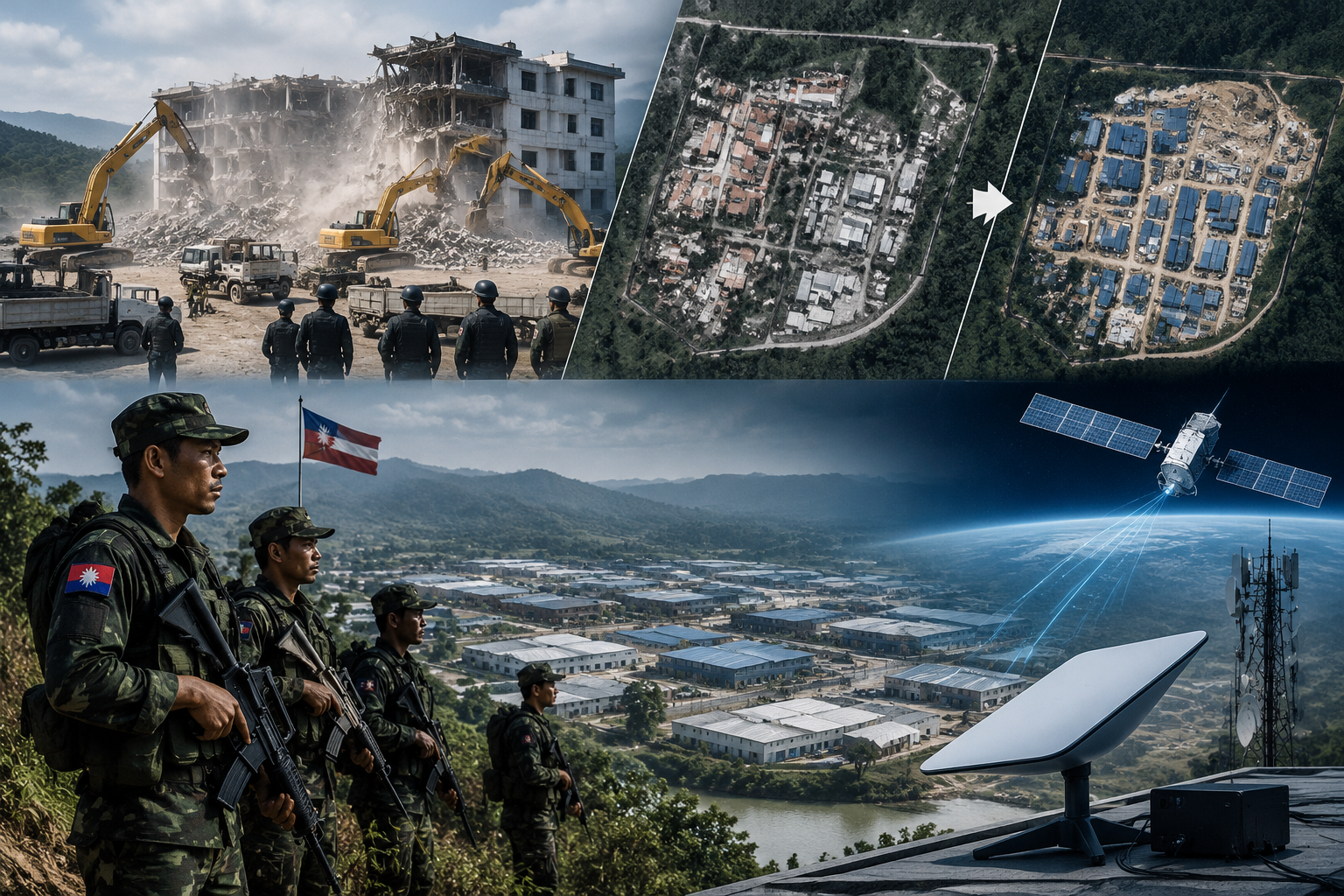
On July 26, 2026, the final 17-story fraud-related building in Myanmar's Myawaddy Shuigou Valley district collapsed with a dull thud, with authorities declaring 77 illegal buildings completely cleared. However, satellite imagery reveals a reality far more complex than the official narrative - less than sixty days later, three new bases have already reconstituted near the original site. This isn't simply "resurgence" but an organized and premeditated industrial transfer and upgrade.
When the demolition dust settled, law enforcement announced complete clearance of the Shuigou Valley area. But satellite images don't lie: by September 2026, three new bases had already risen on what was supposed to be "flattened" land. The Tikaji Village area was empty land in June but by August had sprouted grouped buildings; about 5 kilometers from the original KK Park, a new location called "Qingsong Park" appeared; the "Yongjing Tower" project in Asia Pacific City Block 5 was exposed to have hidden at least 1,500 fraud-related personnel.
A key overlooked data point: Australian Broadcasting Corporation (ABC) revealed that the criminal complex area in Myawaddy expanded from 21.4 hectares in 2024 to 2026. Buildings are being demolished, yet the land occupied is growing larger. Independent analysis based on satellite imagery shows at least 47 new suspicious buildings have appeared around Myawaddy since early 2026. The speed of demolition never matches the speed of construction.
The印象 of scam industrial parks as high walls, electrified fences, and rows of tin sheds is already outdated. New bases are generally smaller than before,选址 farther from densely populated areas. In plain terms: they're not building large parks anymore, but scattering sesame seeds.
Why? Because large parks are too conspicuous - one satellite or cross-border operation can wipe out everything. But dispersed small bases blend into mountain forests, residential homes, or even hide in high-end real estate, posing as real estate companies, resorts, or trading firms. The radius of investigation lengthens, and evidence collection becomes exponentially harder. The stronger the anti-fraud action, the more "anti-reconnaissance" the park's form becomes. This isn't defeat in confrontation, but escalation of confrontation.
The钢筋水泥 has owners, but the people behind it are harder to pry loose. Myawaddy has long been controlled by local armed groups like the Karen National Army. Roads, ports, security, and communications are all in their grip. The fraud industry provides stable cash flow to armed groups, while armed groups provide protection and buffer for the industry. Bound on the same rope, they rise and fall together.
As long as regulatory vacuum remains and interest chains aren't broken, buildings can be repeatedly demolished, and the industry can regrow. Even more troubling, investigators tracking scam groups in border areas reveal these organizations obtain intelligence before crackdowns and evacuate in advance. The action hasn't arrived, yet the people have already left. What lies behind this is more concerning than the buildings themselves - it knows you're coming.
If catching fraud used to mean catching "people," now it means catching "links first." On July 14, 2026, AFP analysis of satellite photos and drone imagery pointed to a sharp increase in Starlink usage by scam organizations in Myanmar. Subsequently, the Myanmar military seized 30 Starlink receivers at KK Park - communication shifted from ground cables to satellite links. You cut cables, cut base stations, they just look at the sky.
Money matters are also solved: shifting to cryptocurrency, cross-border, anonymous, instant settlement. How do they get people? Recruitment changed from smuggling to online recruitment. Numerous recruitment ads appeared simultaneously on overseas social platforms, starting salaries at 20,000 baht, with many positions directly targeting "American market" or "European market." These changes point to one conclusion: fraud is no longer a certain park's business, but a detachable, movable industrial chain.
Domestic law enforcement efforts have never stopped. Ministry of Public Security data shows since the July 2023 deployment of special work to combat Myanmar northern telecom network fraud crimes, relying on China-Myanmar law enforcement security cooperation mechanism, directing joint operations by public security organs in Yunnan, Zhejiang and other places, as of the end of 2024 cumulatively captured over 53,000 Chinese nationality fraud-related criminal suspects, completely destroying the "Four Major Families" criminal group in Myanmar's northern Kokang region.
But the Ministry simultaneously pointed out that overseas den operation scales remain large, with numerous scam dens packaged as "technology parks" and "development zones." Myawaddy's current situation is exactly the footnote to this judgment: when crackdown focus concentrated on Myanmar's northern Kokang area, neighboring Myawaddy is absorbing overflowing criminal production capacity and demonstrating more resilient vitality.
Facing continuously upgrading scam patterns, the public needs to increase vigilance. If you experience telecom network fraud, immediately call 110 or 96110 to report; if you discover someone around you participating in overseas scam dens or knowing but not reporting, report to local public security authorities. The Ministry has opened the 12339 reporting channel, encouraging informed parties to provide leads. For those currently engaged in "high-paying work" overseas, verify the authenticity of recruitment information - almost all recruitment requiring smuggled exit, abnormally high base salaries, or refusing to disclose specific work content are fraud traps.
本站爆料正文为用户真实投稿(UGC),AI 仅用于跨语言翻译与辅助整理,全部内容均经人工审核核实后发布,仅供公众防骗参考。