Inside Phoenix Park: Unveiling the Criminal Chain of Telecom Fraud Factories in Myawaddy, Myanmar
【I. Deceptive Recruitment and Cross-Border Trafficking Traps】
In March 2025, Chen Hao, a 28-year-old programmer from Jiangsu, encountered a job posting on a recruitment platform offering a "technical position at a Southeast Asian gaming company" with a monthly salary of 38,000 RMB, including "airfare, visa, and accommodation." The interview was conducted solely via video call by an individual claiming to be an HR representative from "Singapore Starshine Technology," who presented office environment videos actually stolen from legitimate enterprises.
Upon arriving in Bangkok, Chen was forced into a modified freight truck for illegal border crossing into Myanmar. Two armed men confiscated his phone and blindfolded him with a black hood. After six hours of bumpy travel, he overheard guards speaking Burmese about delivering "another piglet," realizing too late he'd fallen into a scam.
Similar cases reveal victims lured by roles like "game promoter" or "cross-border e-commerce operator." According to Myanmar anti-fraud volunteer Lin Feng (alias), Phoenix Park collaborates with Thai black tour agencies to form a complete chain: "fake recruitment - human trafficking - park delivery." Trafficking routes include land (Bangkok-Mae Sot-Myawaddy) and air (Bangkok-Yangon-Shwe Kok) corridors, with per-person costs of $5,000-8,000 billed to victims "in installments after employment."
Recruitment agents even forge government documents. In April 2025, Yunnan police intercepted batches of counterfeit "Myanmar Investment Commission foreign labor permits" with official-looking seals.
【II. High-Security Compounds and Human Control Systems】
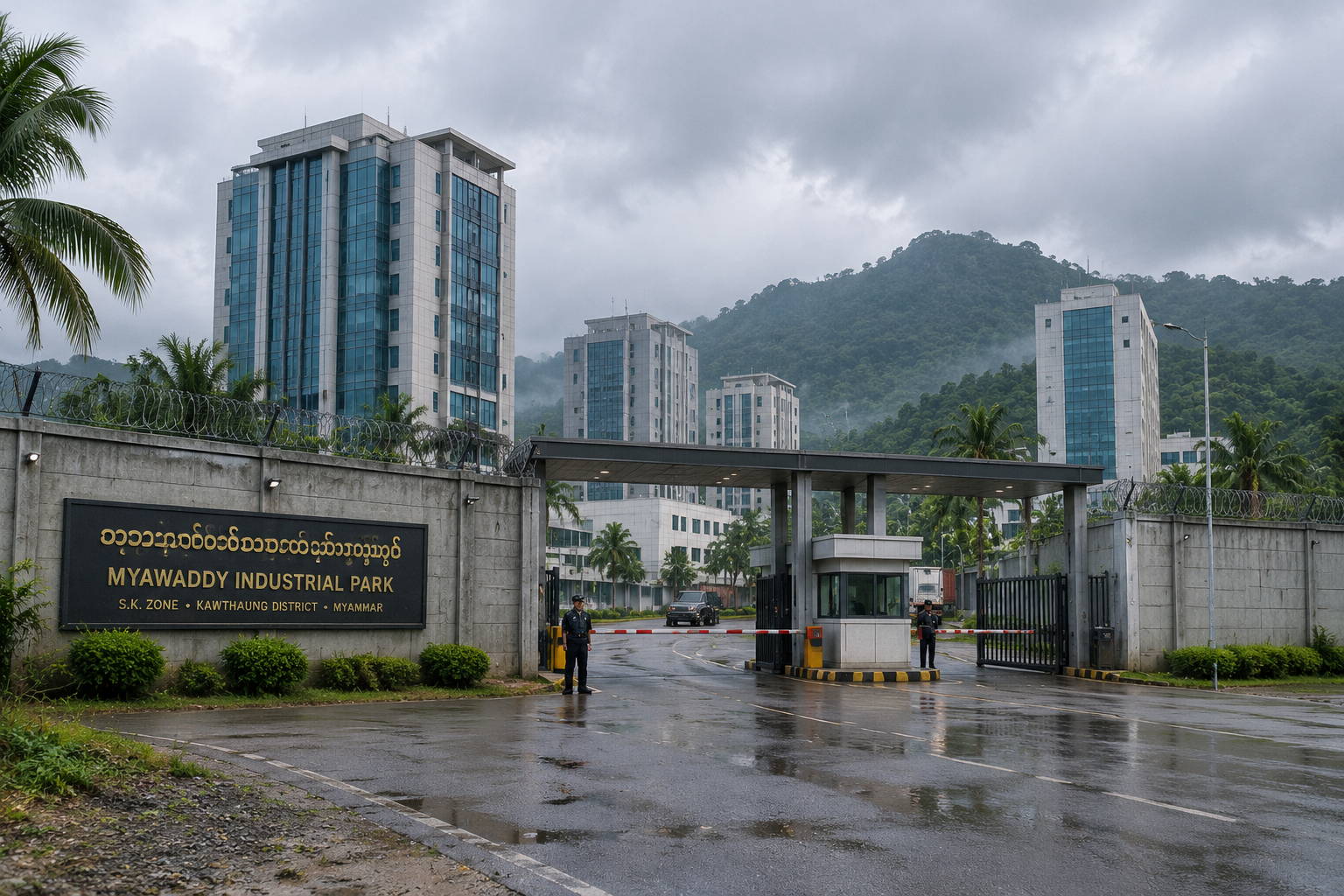
Spanning 120,000 square meters, Phoenix Park is surrounded by 3-meter electrified fences with watchtowers every 50 meters. The main entrance features metal detectors and facial recognition systems storing data on over 2,000 victims. Escaped victim Li Wei (alias) described armed guards—mostly retired soldiers from the Kachin Independence Army—equipped with AK-47 rifles and stun batons.
Victims are confined to eight-person dormitories with barred windows and 24/7 guard posts. Their schedule runs from 6:30 AM wake-up to 10:00 PM forced "work," allowing only two 10-minute bathroom breaks. Dormitories have 360-degree surveillance cameras, with pressure sensors under beds to prevent hidden communication devices.
In June 2025, a riot erupted when 30 victims attempted to break windows and escape. Guards deployed tear gas and opened fire, critically injuring five. Managers subsequently destroyed all victims' phones by soaking them in saltwater and implemented a "group punishment" system—denying food for three days to entire dormitories for监管 failures.
The park enforces "passport confiscation." New arrivals must pay $30,000 "ransom" to retrieve documents, though most cannot afford it. In August 2025, after Guangdong victim Wang Fang's family wired $21,500, scammers reneged on the agreement and sold her to another compound.
【III. Criminal Operation Models and Romance Scam Factories】
Phoenix Park specializes in "pig-butchering" scams through four production lines: "lead generation," "scripted conversation," "technical support," and "money laundering." Daily morning meetings distribute "pig lists" containing victims' detailed profiles—age, occupation, marital status, etc.—from 20+ data fields.
Scamming software is custom-developed. The technical team uses fake "MetaTrader 5" platforms with real-time back-end control over cryptocurrency prices. In July 2025, Jiangsu victim Ms. Liu invested $265,000 in "Bitcoin options" on a fraudulent platform, with funds diverted to shell companies controlled by the park.
Conversation scripts meticulously dictate tone words. New recruits must memorize "Three-Day Crash Course in Fraud Scripts," covering modules like "building trust," "inducing large investments," and "handling doubts." Police-intercepted chats reveal scammers debating tactics: "Claiming 'mother hospitalized' evokes more sympathy than 'project glitch.'"
Money laundering spans 23 countries. Funds disperse through "payment runners" to 5,000+ personal accounts before conversion via underground banks into kyat, USD cash. In September 2025, joint Sino-Myanmar operations seized 2.3 tons of cash in a Yangon safehouse, including RMB, USD, and kyat denominations.
【IV. Physical Punishments, Human Trafficking, and Escape Ordeals】
Underperformers face "water cages," electric shocks, and suspension beatings. In May 2025, escaped victim Zhao Qiang showed undercover footage of a Sichuan man submerged in a 1-meter-deep pit with an iron cage over his head, only his nostrils exposed.
"Compensation" demands exceed victims' means. According to internal documents, victims must pay $75,000 in fees—including $50,000 for "trafficking," $30,000 for "board," $20,000 for "training," and $10,000 for "equipment damage"—to leave. In August 2025, Shandong victim Zhang Lei's family sold property to raise $97,000, only for scammers to demand $136,000 or threaten "organ harvesting."
The trafficking market thrives as a black-market industry. Myanmar's "Light Action" anti-fraud group reports Phoenix Park resells 200-300 victims monthly: "tech specialists" fetch $150,000-$200,000, while ordinary "call agents" sell for $30,000-$50,000. In September 2025, Cambodian police rescued 127 victims, 43 previously held at Phoenix Park.
Few escapees survive unscathed. In July 2025, Hunan girl Zhou Ting fled during monsoon floods, hiding in jungles for three days before being found by villagers. She suffered liver and kidney failure from contaminated water and remains hospitalized in Yangon.
【V. Blood-Stained Advocacy and Anti-Fraud Warnings】
Phoenix Park exhibits three red flags: standardized recruitment scripts (mentioning "Southeast Asia," "game promotion," "covered airfare"), vague office locations (only stating "Shwe Kok Special Economic Zone"), and illegal hiring practices (refusing office environment video verification).
To identify fake jobs, verify four elements: corporate registration (via Tianyancha), physical address (compare with Google Street View), recruitment email (legitimate firms use corporate domains), and interview process (multinational companies rarely hire solely through video calls).
If scammed, take three immediate actions: preserve chat records and payment proofs; report to the Chinese Embassy in Myanmar (consular protection hotline: +95-9-43209657) and Myanmar police (199); submit clues via the "National Anti-Fraud Center" app.
Through 2025's "Operation Thunderbolt," Sino-Myanmar forces destroyed three weapons depots and five money-laundering dens near Phoenix Park. However, 17 Southeast Asian scam compounds remain operational, ensnaring over 120,000 victims. Myanmar Chinese Chamber of Commerce President Wu Mindun urges: "Never trust overseas high-paying jobs demanding upfront fees. If relatives disappear, contact the Chinese Embassy or Myanmar's anti-fraud hotline 191 immediately."
本站爆料正文为用户真实投稿(UGC),AI 仅用于跨语言翻译与辅助整理,全部内容均经人工审核核实后发布,仅供公众防骗参考。